Week 13: New books, fresh games, and a call for courage.
- Sheryl - Lead Guide
- Dec 1, 2024
- 5 min read
This week we were very excited to receive our shipment of Science of Reading aligned books from West Coast Literacy - the Dandelion World Series (non-fiction decodable books) and their "catch-up" series, which is directed at older learners.

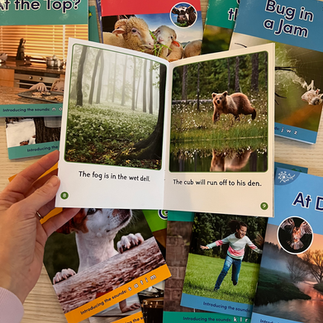



For those who may be unfamiliar, the Science of Reading is a body of research that explains how the brain learns to read and emphasizes the importance of phonics, fluency, vocabulary, and comprehension in literacy instruction. By adding these evidence-based resources to our collection, we’re ensuring that all children - no matter their learning style - have access to materials that support their development as confident, capable readers.
These books feature carefully designed content that enhances decoding skills, reinforces phonemic awareness, and makes reading an engaging experience.
Many decodable books contain illustrated, cartoon-like drawings; which makes sense as they're aimed at a very young audience. Unfortunately, if you're an older struggling reader, these books can be uninspiring, and in some cases even result in feelings of shame. I've heard this from my own eldest daughter who would often refer to them as "babyish" and resisted reading them. That's why I was so excited to discover these books, and the series that is made especially for an older audience. The characters are older, the images are similar to a graphic novel, and the plot of each series is engaging and mature. On Tuesday morning, when the children came into studio, they very quickly noticed these new resources on the shelf. When one of our older learners sat down and started flipping through the book, he was immediately intrigued by the images and realized he recognized many of the words. He decided to give it a try. He pointed to the word at the top of the page and asked another learner what it said. "Chapter 1" she replied ("chapter" is beyond the phoics skills he's learned thus far). He sat back and began reading the book aloud. Another hero overheard and said, with amazement, "Is W reading a chapter book?!" to which W replied, with a big smile and a visible puffing of his chest, "Yah, I'm reading a chapter book!" His pride is so well-deserved. He sat down and finished the book, and promptly began on the second in the series. For those children who are not yet ready for these books, or for when these become too difficult, we have a large collection of non-fiction decodable books full of beautiful photographs to captivate and inspire exploration, no matter their age.
One of the brilliant ways Acton Academy inspires learning, without grades or an adult telling children what to do, is gamification. We can all name certain things we're intrinsically motivated to do, and those that we would be less inclined to pursue were it not for some extrinsic motivating factor. For one of my daughters, she is extremely intrinsically motivated in any creative pursuit (drawing, crafting, making board games, cutting up scraps and sewing together stuffies or clothes for her toys).....but math? Reading?? That's a whole other story. Those are difficult for her, and she can't see the immediate benefit to learning them. I can tell her until I'm blue in the face (and I've tried) how important these things are to learn, how much she'll need them in her life, how they'll unlock worlds for her...all true, but ultimately not very inspiring. For these things, she needed some extrinsic motivating factor to entice her to give them a try.
The people who began Acton Academy knew that forcing a child to learn something kills the love of learning. They also acknowledged that being proficient in reading, writing, and math is necessary if one is to lead an inspired, independent, successful life. The solution? Gamification. By gamifying learning, children who may otherwise have resisted doing certain things are given reason to try - an exciting game their peers are participating in, with real-life consequences and rewards.

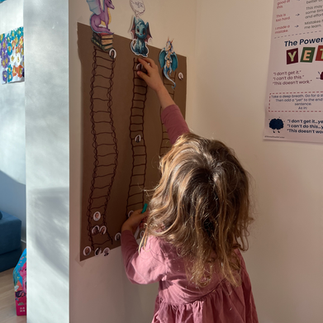

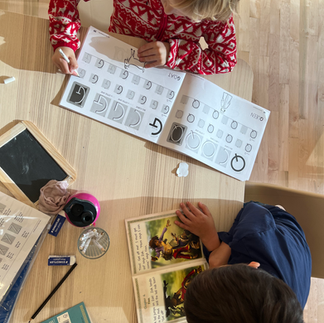


In our studio, this has manifested in the form of game maps posted on the walls. These maps track children's progress through the various e-learning programs they're using. They move their avatar along the map as they progress through the program, and this in and of itself has created huge motivation in studio. That simple act of physically moving your avatar along a map, seeing how far you've come and how far away your next goal post is, has increased the energy around these programs. At various stages on the journey, after completing a number of lessons, learners ring a big bell and receive a badge to signify their progress which is displayed on their crest in studio. This visual accumulation of badges is another big motivator for some learners. Similar maps are in place to incentivize progress through handwriting books, mathwork, and reading. The result? The adult in the room never has to tell a learner to sit down and grind through their handwriting book, or work on their math exercises. If the game is set up well, if it's exciting enough, they'll choose to play. I've seen this in action with my own daughter, who in September was barely reading and able to do only very basic early math, now reading chapter books and working through multiplication and division in her math program.








As November winds down and December approaches we can certainly feel the chill in the air, but that never stops these heroes from venturing outdoors! This hard-working crew has been building a fortress to withstand the snow up on the hillside, complete with a bridge, a medicine stockpile, and food to last the long winter (snail shells and bark). Each afternoon they come back into studio with rosy cheeks and noses, smiles ear to ear, and big plans about tomorrow's additions to the fortress.
We concluded our week with a powerful discussion revolving around this scene from Harry Potter: one in which Harry, Hermione, and Ron are sneaking out of Gryffindor House and their shy, meek friend, Neville, confronts them. We discussed whether we would do the same; stand up to our friends when they're doing something wrong, even when we're scared to do so? Why or why not? Then, whether we would rather have a friend who lets things go and overlooks mistakes, or a friend who will stand up to you even when it’s hard? Why or why not? The call to action after this discussion was as follows: going forward, when you observe one of your friends breaking a studio promise, will you stand up or step aside?
These are tough moments all of us face at some point, or many, in our lives. At Acton Academy, we don't shy from these inevitable challenges, we lean into them. We shed light on them and give children the chance to practice and fail cheaply, early, and often - when the stakes are low so that when they're older, and the stakes much higher, they're well equipped to handle them.
In the words of Albus Dumbledore, "It takes a great deal of courage to stand up to your enemies, but a great deal more to stand up to your friends."


Comments